Eider
The UK’s heaviest and fastest flying duck species with an interesting ‘Carry On’ call!
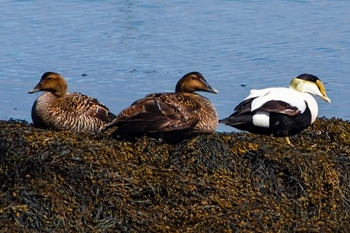 I often get asked what my favourite animal is, but that is too difficult to answer. In my job my life is consumed and surrounded by nature every day, so I have many favourite species, which I have had to categorise down into owls, deer, waders, Hirundinidae (swallows/house martins, sand martins), chalk downland plants, trees, mustelids, farmland birds, raptors, ancient woodland indicators… You see where this is going. So, I thought I would kick this year off with my favourite duck, the eider (Somateria mollissima).
The eider is one of the most iconic seabirds, known for its robust build; striking male plumage; the male’s call during the breeding season not that dissimilar to Kenneth Williams’ “Ooooo”; and soft, insulating feathers, which they use to line their nest and have been widely used for humans’ comfort.
A member of the duck family Anatidae, it is the largest duck regularly seen in UK waters and a true seaduck that spends most of its life at sea or along rugged coastal shores.
Description
An adult male eider in breeding plumage is unmistakable: a large, chunky duck with bold, contrasting colours — predominantly white upperparts and black underparts with a distinctive pale green patch on the nape of the neck and a pale yellow-grey bill. Females are more subdued in appearance, as with most female birds, with mottled brown and grey feathers with delicate barring providing excellent camouflage when nesting. Both sexes have a characteristic wedge-shaped bill designed for powerful diving and shellfish feeding, and eiders are also the UK’s heaviest and fastest flying duck species.
Feeding
Eiders are exceptionally adapted to coastal life. They dive skilfully, sometimes to depths of several metres, to forage for blue mussels and other molluscs, together with crustaceans and echinoderms (e.g. sea urchins). These strong swimmers often feed by upending or diving, propelled by their wings and legs in pursuit of prey on the seabed.
Breeding
Breeding usually begins in late spring, with females laying and incubating 4-6 eggs in shallow nests on coastal islands or quiet headlands for 25-28 days. The nest is heavily lined with down feathers plucked from the female’s own breast, known as ‘eiderdown’, which is prized historically and still used in high-end bedding. After hatching, ducklings are relatively mature and soon enter the water; they are often cared for in large crèches — groups of mixed broods watched over by several females.
Migration and behaviour
Unlike many other waterfowl, the migration habits of eiders vary across their vast range. In Arctic and sub-Arctic regions, many populations undertake significant seasonal movements, retreating southward in winter to escape ice-covered waters. In contrast, British and Irish eiders are largely sedentary or make only short movements outside the breeding season. Nevertheless, wintering numbers along the UK’s east coast are bolstered by migrants arriving from continental Europe.
Where and when to see eiders
Eiders are highly social birds and can be observed year-round in most UK water. with the exception of much of the Solway Firth, Cardigan Bay and the Bristol Channel, but the best time and places depend on what you want to see.
They breed and nest in colonies around the northern coasts of Scotland and northern England and can be found almost continuously along these shores from April through July.
Outside of breeding season, they may form large flocks, especially in sheltered coastal waters, where hundreds of birds can be seen bobbing together. During their summer moult, adults temporarily lose the ability to fly and gather in dense, often conspicuous rafts of birds.
According to the BTO, the greatest concentrations are along the North Sea coast from Shetland to North Yorkshire, and in the northwest in Argyllshire and the Clyde estuary, northern parts of Ireland and Morecambe Bay.
Folklore and cultural connections
The eider duck has long held a place in British folklore, especially in northeast England. In local tradition, the bird is often called ‘St Cuthbert’s duck’ or ‘Cuddy’s duck’, after the 6th Century Anglo-Saxon St Cuthbert, who lived as a hermit on the Farne Islands off Northumberland. Legend holds that he protected the eiders and other seabirds nesting there, instituting what are thought to be among the earliest bird-protection laws on record.
Did you know?
- Typical lifespan: 14 years with maximum aged bird reaching 35 years, 6 months, 26 days
- Alternative names: Gaelic: Colc, French: Eider à duvet
- UK winter population: 86,000
- Collective noun: Raft (resting on water), Plump (bobbing on waves)
Head down to the coast and look out for these magnificent birds and you will see why they are my favourite duck!
Megan Lock
Advisory
Photo credit: Paul VanDerWerf