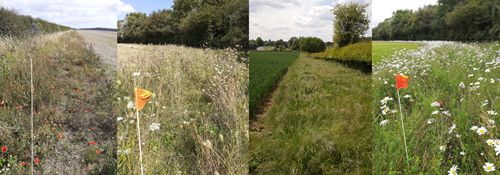
For over a decade, the Farmer Cluster initiative, pioneered by the Game & Wildlife Conservation Trust (GWCT), has transformed how conservation works on farmland.
Background
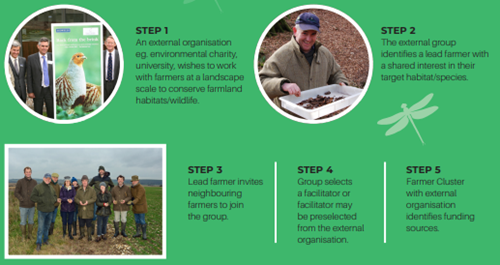
The idea is simple but powerful: neighbouring farmers come together to improve wildlife habitat at a landscape scale, supported by expert facilitation and shared local knowledge. The Farmer Cluster concept began in 2014 as a GWCT pilot funded by Natural England. It grew rapidly under the Facilitation Fund, with over 220 clusters now covering more than 450,000 hectares (compared to 224 National Nature Reserves covering 116,000 hectares in England).
Each cluster is coordinated by a trained facilitator who supports farmers in sharing knowledge, monitoring progress, and applying for agri-environment support.
The story so far
The Allenford Farmer Cluster, one of the first of its FiPL, kind formed as a pioneer in 2013, and the Martin Down Farmer Cluster (formed in 2017), both founded with GWCT support, and now represent some of the most mature examples of collaborative conservation in action. Their 2017–2024 reports highlight major gains for farmland wildlife, from more pollinators and farmland birds, to thriving populations of grey partridge, and other redlisted priority species. These results show what can be achieved when farmers take ownership of biodiversity goals across real working landscapes.
GWCT’s Farmland Ecology Unit has been at the centre of this movement from the start, not only helping to develop and monitor the Clusters in England but also leading the science behind how the model can be adapted further afield. The FRAMEwork project, a multi-partner, Europe-wide project tested whether the Farmer Cluster concept could work in different countries and farming systems. A recent publication led by GWCT scientists describes how eleven new Farmer Clusters were formed across nine nations, each with unique farming systems and landscapes, from arable plains to olive groves, proving that this “bottom-up” approach can unite farmers, encourage biodiversity-friendly farming practices, and bring together rural communities across Europe.
| Project / Region |
Area & Participants |
| Martin Down Farmer Cluster (2017–present) |
- 15 farms
- 5500 ha
- (Hants & Dorset)
|
| Allenford Farmer Cluster (2013–present) |
- 12 farms
- 7500 ha
- (Wiltshire,Hampshire)
|
| FRAMEwork Project (paper 2021–2025) |
- 11 pilot clusters
- 9 countries across Europe
- 100+ farmers
|
Farmer cluster successes!
The Allenford Farmer Cluster boasts quite the list of wildlife success stories. Examples include a 44% increase in butterfly species diversity since monitoring started in 2017, as well as increases in hedgehog numbers, and successful growth of rare arable plants such as the endangered Pheasant’s-eye flower. Furthermore, the Cluster enjoys sightings such as quail, corn buntings, great bustards sea eagles, turtle doves and glowworms, many of which other farmers might only dream of seeing!
Meanwhile the Martin Down Farmer Cluster has its own encouraging success stories since monitoring began in 2017. These include a 125% increase in corn buntings between 2017 and 2021, a 28% increase in butterfly species diversity since 2017, and 26 arable flora species of national importance spotted. Excitingly, there have also been sightings of purple-emperor butterflies, smooth snakes, adders, great bustards, calling quail and carpenter bumblebees across the Cluster.
These local achievements in wildlife trends are even more striking when set against the national picture. Farmland bird populations across the UK have declined by around 62% since 1970, with a further 11% drop in the past five years (DEFRA, 2024). Meanwhile over half of UK butterfly species are now in long-term decline.
However, these biodiversity success stories do not happen by accident, farmers within both Clusters have been putting in the work! Increasing semi-natural habitat by hundreds of hectares, installing turtle dove drinking sites and supplementary feeding songbirds.
|
Project / Region
Martin Down Farmer Cluster (2017 – 2024)
|
Key actions
- Increased grey partridges habitat on 600ha of land
- Wild bird seed mixes, flower-rich margins, cover crops
- Lapwing and curlew monitoring.
|
| Allenford Farmer Cluster (2017 – 2024) |
- Extensive hedgerow restoration and creation of new pollen and nectar habitats.
- Soil management improvements and invertebrate monitoring
- Supplementary feed of birds in winter.
- Collaborative delivery of Countryside Stewardship and SFI-funded options.
|
| FRAMEwork Project (paper 2021–2025) |
- 11 new farmer clusters across Europe.
- Local facilitation & biodiversity planning.
- Farmers supported to co-design and monitor their own environmental outcomes.
|
Claims to fame!
These farmer clusters demonstrate how collaborative, landscape-scale conservation can reverse long-term declines and deliver measurable biodiversity gains. Both farmer Clusters have claims to fame that go beyond the wildlife improvements on the farms as well. While Martin Down Farmer Cluster featured on both Countryfile in 2021, both clusters have appeared on spring watch in 2024, and Allenford Farmer Cluster on BBC radio 4. Helping spread the word about sustainable and collaborative approaches to farming has also earnt Allenford Farmers Weekly awards in 2024 while Martin Down won a National Bees needs award in 2020!
The social benefits of Farmer Cluster engagement are also clear to see, with both Clusters working both internally and with the wider communities to provide education for issues such as hedgehog awareness and even educating Defra and Natural England on farming issues and needs. Both clusters are also hosting crucial scientific research and wildlife friendly initiatives including everything from butterfly banks to regenerative agriculture research.
| Project / Region |
Measured outcomes |
Martin Down Farmer Cluster (2017–2024)
|
- Increased populations of grey partridge.
- Corn buntings increased by 125% between 2017 and 2021.
- Doubled the number of drinking sites for turtle doves and other farmland species.
- 28% increase in butterflies since 2017.
- Lapwing confirmed breeding.
- Head starting curlew.
- Pollinator habitat improvements by 50%.
|
Allenford Farmer Cluster (2017–2024)
|
- 44% increase in butterfly species.
- Increase wildlife habitat through pollen & nectar planting, wild bird seed plots, and cultivated margins.
- Increased hedgehog populations across the cluster.
- Strong farmer collaboration maintained across the group with active knowledge exchange and support from the facilitator.
- Involved with projects such as installing swift boxes, water testing project, and H3 regenerative farming project.
|
FRAMEwork Project (2021–2025)
|
- Improved farmer engagement in landscape-scale management
- Increased knowledge sharing between participants
- Practical biodiversity plans created for each site
- Foundations for long-term biodiversity monitoring established
|
The secret to success?
The European-wide FRAMEwork research confirmed what we’ve seen in Martin Down and Allenford: success depends on. Experiences from the FRAMEwork Farmer Clusters and both Martin Down and Allenford all suggest that local knowledge, peer-to-peer learning, skilled facilitation and trust between the farmers and the facilitator are all key elements to establishing and managing farmer-led conservation. Farmers are most engaged when they set their own biodiversity priorities, whether that’s increasing pollinators or improving soil health, and when they have expert knowledge guiding their initiatives.
GWCT’s ongoing role is to provide the science, surveying and monitoring to gather data, and practical guidance that help these collaborations thrive. From monitoring grey partridge recovery to advising on cultivated margins for arable plants and habitat mosaics, GWCT advisors are helping Farmer Clusters demonstrate measurable outcomes for biodiversity and sustainable farming.
GWCT Senior Farm Environment Advisor and Farmer Cluster facilitator, Megan Lock, has been central to both Clusters’ success. By supporting farmers to plan biodiversity-friendly actions, coordinating monitoring, and applying for funding through schemes such as Countryside Stewardship (CS) and the Sustainable Farming Incentive (SFI) and Farming in Protected Landscapes (FiPL), the Clusters have flourished. Although there is a government ‘Facilitation Fund’ available to pay the wage of a facilitator for a Farmer Cluster, many farmers have also invested their own time and resources to make these improvements possible, by self-funding their Farmer Clusters by contributing £2/ha and delivering benefits to nature, soil and water at their own cost outside of agri-evironment schemes.
As government policy continues to evolve, these findings provide clear evidence that ”bottom-up”, landscape-scale conservation does work, and that empowering farmers to lead is key to reversing biodiversity loss. But they need support, financially to implement and manage these measures, but also monitoring them and get the advice they need.